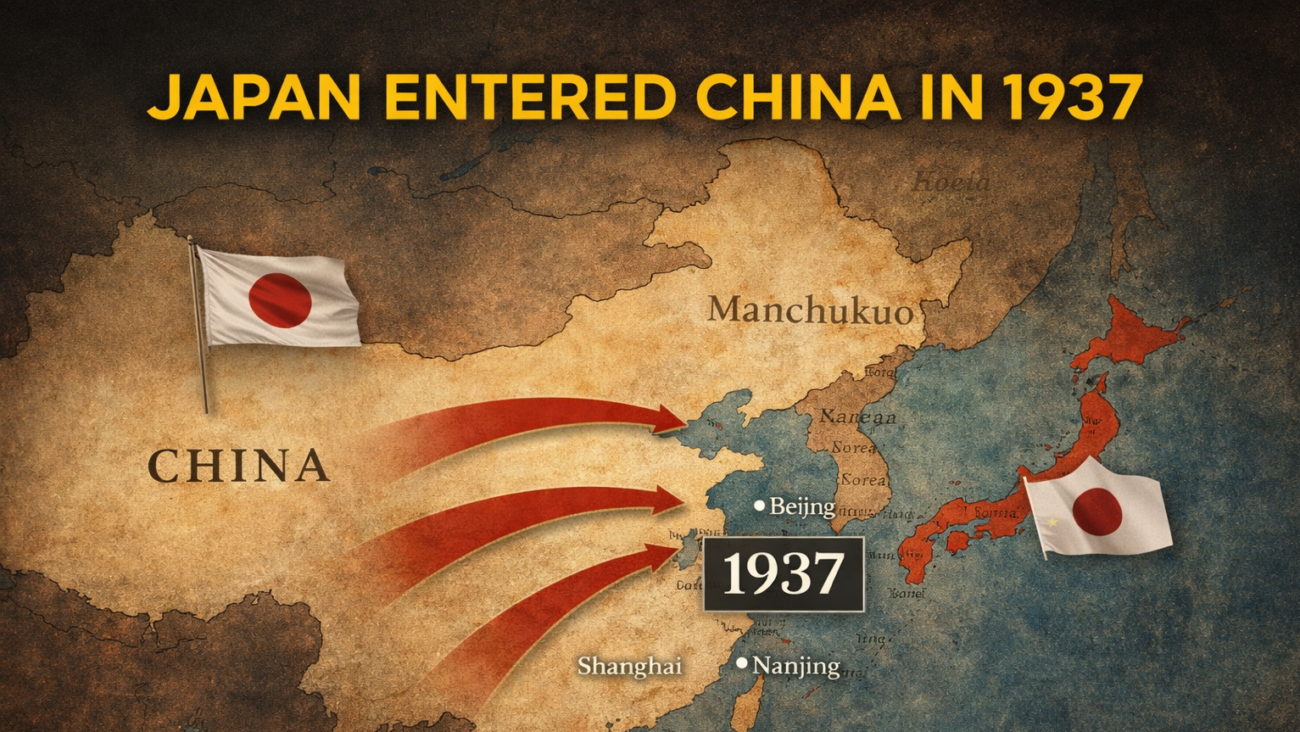
Strategic Confidence and the Road to Invasion
Japan entered China in 1937 driven by confidence built from earlier territorial successes and a belief that military strength could resolve political ambitions.
Tokyo’s leadership viewed China as internally divided, economically weak, and unable to sustain coordinated national resistance.
The Marco Polo Bridge Incident acted as the immediate trigger, but tensions had been building for years through expansionist policies.
Japanese commanders assumed rapid battlefield victories would pressure China into negotiations and surrender.
Early operations supported this belief as major cities fell with alarming speed.
Superior air power, naval reach, and mechanized units overwhelmed Chinese defenses in key urban centers.
These victories shaped domestic narratives portraying the war as nearly won.
However, territorial control demanded long supply lines and constant troop deployment.
China’s leadership avoided decisive collapse by retreating inland and reorganizing forces.
Resistance shifted from conventional battles to prolonged defensive strategies.
Rural regions became increasingly difficult to control despite Japanese occupation of cities.
Local militias and irregular forces disrupted communications and transport routes.
Economic demands grew as the war expanded beyond initial planning.
Japan underestimated China’s geographic scale and population resilience.
Military planners struggled to adapt to a conflict without clear endpoints.
Political leaders continued pursuing victory despite rising costs.
By 1938, the campaign no longer resembled a short war.
Confidence had given way to uncertainty.
Japan entered China in 1937 expecting swift dominance, yet found itself drawn into an open-ended struggle.
Civilian Life Under Occupation and Expanding Violence
As Japan entered China in 1937, civilian populations became increasingly exposed to the realities of modern warfare.
Military objectives blurred as occupation strategies targeted communities suspected of aiding resistance.
The capture of Nanjing revealed the conflict’s darkest dimensions.
Foreign correspondents reported mass killings, sexual violence, and systematic destruction.
These reports damaged Japan’s international reputation and intensified global concern.
Beyond major cities, rural populations endured persistent hardship.
Villages were destroyed during counterinsurgency campaigns designed to eliminate support networks.
Agricultural systems collapsed as land was seized and labor forcibly redirected.
Famine spread rapidly across affected regions.
Displacement pushed millions toward inland cities unprepared for refugee influxes.
Disease followed overcrowding and malnutrition.
Medical services and transportation networks deteriorated under sustained pressure.
Historians estimate more than twenty million civilian deaths occurred during the conflict.
Many died from starvation and illness rather than direct violence.
Chemical weapons were used despite international prohibitions.
Biological experiments later revealed further violations of humanitarian norms.
International responses remained limited and fragmented.
European tensions diverted diplomatic focus.
Condemnations failed to halt the suffering.
Civilian endurance became central to China’s survival.
Families were permanently altered by loss and displacement.
The occupation reshaped social structures and collective memory.
Japan entered China in 1937, but civilians bore the longest-lasting consequences.
Long-Term Consequences for Asia and Global Order
Japan entered China in 1937 without fully recognizing the long-term geopolitical consequences of invasion.
The prolonged war weakened Japan well before wider Pacific conflict began.
Resources consumed in China reduced industrial capacity and strategic flexibility.
Military overstretch later shaped outcomes against Allied forces.
For China, the war forged national identity through shared suffering and resistance.
Political legitimacy shifted during years of occupation and survival.
Communist forces expanded influence through rural organization and sustained guerrilla operations.
These developments reshaped China’s postwar political structure.
Across Asia, memories of occupation influenced diplomatic relationships for decades.
Distrust and unresolved grievances affected regional cooperation.
The conflict accelerated debates on civilian protection in warfare.
International humanitarian law evolved in response to documented atrocities.
Postwar tribunals attempted accountability, though many cases remained unresolved.
Historical memory became contested across national narratives.
Economic reconstruction transformed infrastructure and regional trade networks.
Migration patterns permanently altered demographics across East Asia.
Education systems later incorporated wartime lessons emphasizing restraint and accountability.
Museums and archives preserved survivor testimony.
Historians increasingly view the invasion as a precursor to the Pacific Theater.
The conflict illustrated dangers of miscalculation and unchecked ambition.
Japan entered China in 1937 seeking dominance.
Instead, the decision reshaped Asia’s political balance and global historical understanding.
