Introduction
In 1944, the Eastern Front reached a level of destruction rarely matched in modern warfare.
The Soviet Red Army relied on relentless artillery barrages to crush German defenses and reclaim occupied territories.
Military historians often describe this year as the peak of Soviet firepower.
Factories, rail networks, and battlefield doctrine merged into a single purpose: overwhelming force through sustained artillery dominance.
Red Army Artillery 1944 and the Scale of Soviet Firepower
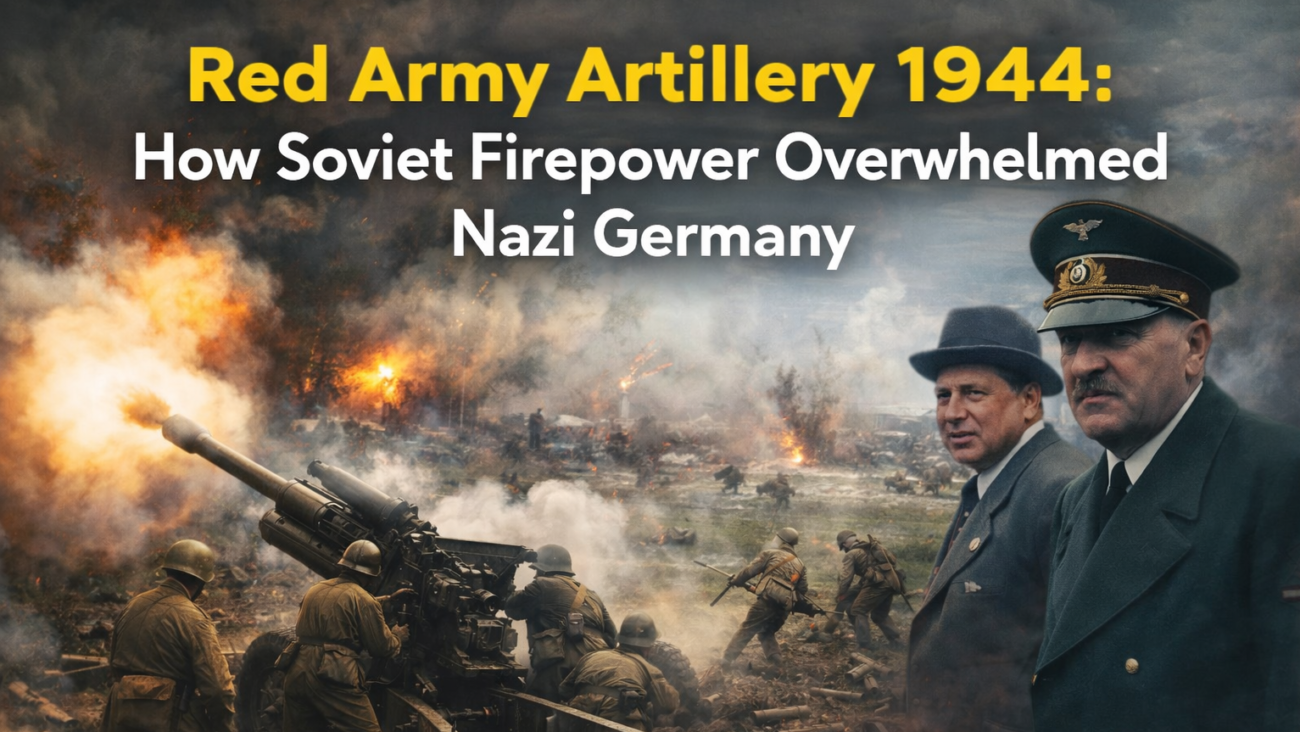
Red Army artillery 1944 represents one of the most intense bombardment campaigns in military history.
Soviet forces fired more than 250 million artillery shells during the year, a figure that stunned both allies and enemies.
This volume nearly matched Germany’s entire wartime shell production.
It demonstrated not only battlefield aggression but also the industrial recovery of the Soviet Union after earlier devastating losses.
Artillery was no longer a supporting weapon.
It became the backbone of Soviet offensive doctrine, shaping every major operation from Belarus to Eastern Europe.
Factories operated around the clock, often relocated east of the Ural Mountains.
Workers, including women and teenagers, produced shells under extreme conditions with minimal resources.
Railways transported ammunition nonstop to the front lines.
Logistics officers treated artillery supply as a strategic priority equal to troop movements and fuel distribution.
Before major offensives, Soviet guns fired for hours or even days.
German positions were systematically destroyed, communication lines severed, and defensive morale severely weakened.
This approach reduced Soviet infantry casualties while maximizing enemy losses.
Firepower replaced maneuver as the decisive factor in breaking fortified German defenses.
By 1944, Soviet commanders trusted artillery more than speed.
The battlefield became a controlled demolition zone, shaped by maps, calculations, and overwhelming shell density.
How Artillery Shaped Soviet Strategy on the Eastern Front
Soviet military strategy evolved rapidly after early wartime disasters.
By 1944, commanders fully embraced massed artillery as the primary instrument of victory.
Red Army artillery 1944 doctrine focused on precision through volume.
Rather than accuracy alone, success depended on saturating entire grid zones with fire.
Offensives like Operation Bagration relied on coordinated barrages.
Thousands of guns fired simultaneously, creating shock waves that paralyzed German command structures.
German defensive lines were carefully studied before attacks.
Artillery planners mapped enemy bunkers, supply routes, and troop concentrations using reconnaissance and partisan reports.
The opening bombardment often determined the battle’s outcome.
If defenses collapsed early, Soviet armor and infantry advanced rapidly with limited resistance.
This method reduced reliance on risky frontal assaults.
Artillery did the work that once required massive infantry sacrifices.
German officers frequently described the barrages as psychologically devastating.
The constant explosions shattered morale long before physical defenses were destroyed.
Communication failures followed intense shelling.
Units became isolated, unable to coordinate counterattacks or retreats.
By late 1944, German forces lacked the resources to respond equally.
Their artillery stocks dwindled while Soviet guns continued firing relentlessly.
Germany’s Decline and the Long-Term Impact of Soviet Artillery
Germany entered 1944 already strained by years of total war.
Industrial bombing, manpower shortages, and raw material scarcity weakened its ability to compete.
Red Army artillery 1944 exposed this imbalance clearly.
While Germany rationed shells, the Soviet Union unleashed unprecedented volumes without pause.
This disparity accelerated Germany’s collapse on the Eastern Front.
Entire divisions were destroyed before close combat even began.
The psychological effect was profound.
German soldiers understood they faced an enemy capable of endless bombardment with no visible limits.
Soviet artillery success influenced postwar military thinking worldwide.
NATO and Warsaw Pact planners studied these operations for decades.
The concept of fire superiority became central to modern doctrine.
Control of industrial capacity proved just as important as battlefield leadership.
Civilian populations also felt the consequences.
Cities and infrastructure across Eastern Europe suffered extensive destruction from prolonged shelling.
Yet, from Moscow’s perspective, artillery shortened the war.
Faster victories meant fewer years of occupation and devastation.
By 1945, Soviet artillery dominance was unquestioned.
It stood as a defining factor in Nazi Germany’s defeat.
Red Army artillery 1944 remains a powerful reminder.
Wars are won not only by soldiers, but by factories, logistics, and relentless preparation.
